 |
| Adam with his inferiors. |
In order to create a sustainable society, we must shift our perspective. Humanity needs to become aware of their actions, and view themselves as agents that participate with their environments, as their environments participate with them. We need to create infrastructure and lifestyles that interact with our environment in a symbiotic way. Ebenezer Howard believes "Garden City" is the answer, but is it?
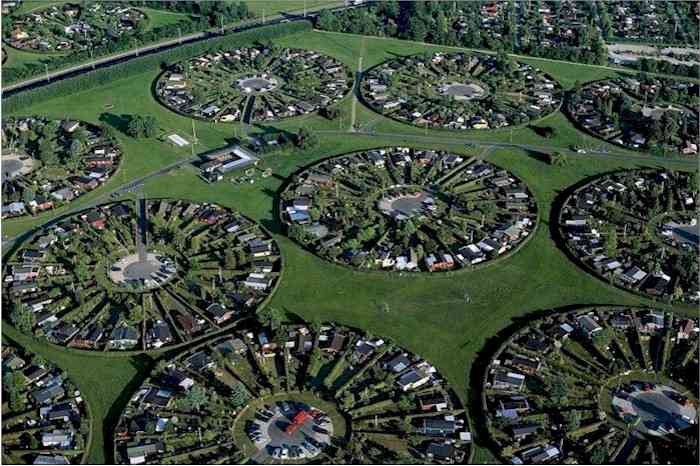
A documentary I watched a few years ago in which city planners created a suburb in Colorado based on some of the same principles as Garden City. Unfortunately, I can't remember the name of it or I would link it here. The suburb was circular in shape, with the homes of families on the perimeter and a community living space in the middle. Kind of like these housing plots in a suburb of Copenhagen, Denmark.
 |
First, the people who are able to afford a transition into places like a Garden City tend to be people from affluent, privileged communities. Rarely do those of a lower class, people who stand to gain the most from a sustainable lifestyle, have access to these kind of environmental endeavors. Underprivileged populations don't have the money to invest in cutting-edge, energy-efficient technology. They likely also don't have the resources or job security to uproot their lives and move to a utopian suburb on the outskirts of town. This brings me to my second point. Is it really environmentally responsible to create entirely new sustainable communities and leave our previous unsustainable communities in the dust to rot and decay? Or should we work on improving our already existing infrastructures? Professor Brown said in class that lots of people have tried to create the perfect utopian society, but none have succeeded. Maybe we should shift our focus from creating the best community ever to bettering what we already live in. If we work on improving our current systems, then all populations in the community are better off, not just the ones with privilege.
