Wednesday, September 17, 2014

While reading the Roseland chapter for next week I was really into all the examples of water-saving techniques that were given. One example in particular caught my attention, in which a community in Durham, Ontario installed half the homes in a new development with energy-and water-efficient appliances and fixtures, and the other half received standard installations. A comparison study done on the homes found that the energy-and water-efficient homes had a 22% reduction in water consumed, a 13% reduction in energy consumed, and a 9% reduction in natural gas consumed per day! And a 1.19 ton reduction in CO2 emissions per year. Oh, and the appliances paid for themselves after 3.4 years (Veritec Consulting Inc., 2008 via Roseland, 81). 

So this example got me thinking that I don't actually know a lot about what is on the market for water- and energy-efficient appliances, or even how they work. And if I don't know, maybe others don't know either... So what I've decided to do this week is a survey of what's out there, how it works, and what its effect is on consumption. For the sake of the readings, I will focus on water-saving technologies.

There are two big programs in the appliance world, both sponsored by the EPA, WaterSense and ENERGYSTAR®, which have identified water-efficient appliances, fixtures, accessories, and systems that reduce consumption. These appliances have the WaterSense or ENERGYSTAR® label so consumers know they are backed by the EPA.

There is some debate about the breakdown of water consumption by appliance for indoor residential use. This chart from Winnipeg, Canada closely reflects the numbers the EPA uses  (winnipeg.ca) (epa.gov/greenhomes).

Toilets

As you can see above, toilets are the largest contributor to water consumption, accounting for a third of all water usage. In 1992, the Energy Policy Act mandated that new toilets built cannot consume more than 1.6 gallons of water per flush (epa.gov/WaterSense). Before that, toilets consumed between 3.5 and 7 gallons per flush (howstuffworks)

There are several options for how a toilet can lower its water consumption, so I'll highlight the common methods.


Low-Flow

Low-flow toilets use gravity or pressure-assisted mechanisms to help clear waste. The gravity style toilet is what most of us are accustomed to, where the water from the tank is dropped when you flush, causing it to flush through the bowl. The pressure-assisted toilets use a compressed pocket of air to push the waste clear (howstuffworks).


Dual Flush

Dual flush toilets have two settings - half flush and full flush - based on which button you select (these are the toilets IKEA uses). Half flush, for liquid waste, uses 0.6 gallons of water per flush, on average. Full flush, for solid waste, uses 1.6 gallons of water per flush, on average (howstuffworks). Basically, these toilets don't use a siphoning tube, which most toilets use, to suction out the waste. Instead, they have a larger hole in the bottom that allows water to more easily clear waste (howstuffworks).

Faucets and Showerheads

High-efficiency faucets can save a family 700 gallons of water per year, which is roughly enough water for 40 showers (epa.gov/watersense). WaterSense labelled faucets must have a maximum flow rate of 1.5 gallons per minute (gpm) at a pressure of 60 pounds per square inch (psi). There is also a minimum of 0.8 gpm at 20 psi to ensure quality performance (epa.gov/watersense). There are a couple different ways faucets become highly efficient.
Picture retrieved from plumbingsupply.com.


Aerators add air to the stream of water to increase sensation of flow and reduce splashing. Laminator flow devices force the water stream through several small openings, creating a uniform flow that reduces splashing (epa.gov/watersense).


The average showerhead has a water stream of 2.5 gpm, or 40 gallons per day for an average American family. The WaterSense label limits the stream to 2.0 gpm, but many high-efficient showerheads are lower than that (epa.gov/watersense). The high-efficient showerheads work through flow restrictors, which limit the amount of water that can flow from the head (speakmanshowers.com). These technologies also use less energy, since the hot water resources are reduced.

Washing Machines

The average washing machine uses 41 gallons of water per load - think about how much that is! High-efficiency washers use 35-50% less water and 50% less energy (epa.gov/greenhomes). High-efficiency washers don't have the traditional agitator most washers have, instead they rotate clothes clockwise and counterclockwise so that the laundry rubs against each other. This requires a different type of detergent, because the increased rubbing causes more bubbles to form and the reduced amount of water used can leave residue behind if traditional detergent is used (howstuffworks). New technology can even detect the size of the load and fabric type, and make tailored washing cycles based on that data.

Hot Water Systems

Water heating is the third largest energy expense in the average home, after space heating and cooling (epa.gov/greenhomes). Here are a few of the common ways to reduce energy consumption.


Tankless

Image retrieved from energy.gov.
Also known as demand-type or instantaneous water heaters, tankless heaters supply water only when it is needed, thereby eliminating the need for storage tanks. A heating element heats the water before it exits the faucet, as shown in the image to the right (energy.gov)


Solar

There are different types of solar heating methods, which you can read about in detail here if you like. Essentially, each type has a solar collector and a storage tank. The solar collector is an insulated box, made of heat-retentive material, with tubes inside for water flow. The storage tank holds the water. The solar collector heats up the water from the sun and stores it in the tank. Active heaters pump the water through the tank electrically and passive heaters allow gravity or the ability for water to rise to pump the water (howstuffworks).


Congratulations! You've now got a basic understanding of the most common water-saving appliances for residential homes. I hope that wasn't too boring. 
In case it was, here's a cat gif for your patience:


Sunday, September 14, 2014

Say Hello to Lionel!

For my personal project I decided to give up my car for a semester. A few days before school started up again I bought a 1986 Tomos a3 (that's a moped) and was already rebuilding it when the project was assigned. I'm proud to say tonight, almost three and a half weeks after I bought the moped, it is running! I broke it down, repainted everything, put a brand new engine in, and rewired the whole thing. Basically, I replaced everything on it except the transmission. It was a long process, but I look forward to sharing how it got from this...

to this...
 to this!


Now the hard part begins! Not using my car will be challenging, but I hope to show that people on a low income can afford cheap (and stylish!) transportation. This semester I will track my mpg, cost of maintaining, the cost and time spent of rebuilding, and test the distance one can travel on this. I also hope to discover how much it can carry. For example, if I lived in a food desert, how many trips would I need to make to the next town to get a week's worth of groceries home?

Here's a video of my partner, Paxton, riding the bike. Rudy, our dog, wants to ride too.


Oh, and his name is Lionel, because Lionel Ritchie had the number one song the year it was built, 1986. So if you see me riding around town, just say... 
My actual bumper sticker

Sunday, August 31, 2014

Something Aldo Leopold mentions in his essay stuck out to me because it is a concept I have worked with before. As a student of religion here at Indiana University, I studied how deeply Biblical ideologies have shaped mankind's perspective on their role in the world. Specifically, the idea of anthropocentrism, wherein God created Earth for humans to have have dominion over. In Genesis 1:26 God says "Let Us make man in Our image, according to Our likeness; and let them rule over the fish of the sea and over the birds of the sky and over the cattle and over the earth, and over every creeping thing that creeps on earth." That sounds pretty creepy if you ask me...

Adam with his inferiors.
So, when Leopold brings up Abraham's perspective that land has no intrinsic value other than to supply him with milk and honey, it reminded me of that Bible verse. Of course humanity has created society with complete disregard to our environment; Earth was created for us! We can build wherever we want, fish as much as we want, and pollute as much as we want because Earth is ours. We own it. This perspective is deeply engrained in our culture, policies, behaviors, and attitudes.

In order to create a sustainable society, we must shift our perspective. Humanity needs to become aware of their actions, and view themselves as agents that participate with their environments, as their environments participate with them. We need to create infrastructure and lifestyles that interact with our environment in a symbiotic way. Ebenezer Howard believes "Garden City" is the answer, but is it?


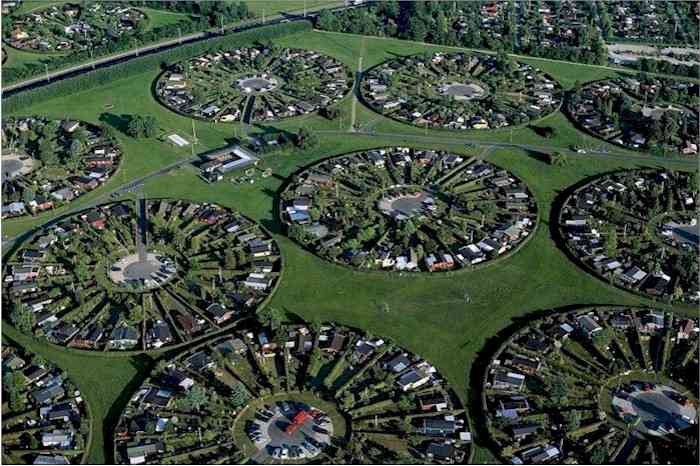
A documentary I watched a few years ago in which city planners created a suburb in Colorado based on some of the same principles as Garden City. Unfortunately, I can't remember the name of it or I would link it here. The suburb was circular in shape, with the homes of families on the perimeter and a community living space in the middle. Kind of like these housing plots in a suburb of Copenhagen, Denmark.


The houses were built with high-tech features like solar panels, energy-efficient appliances, and sustainable architecture. Like Garden City, the Colorado suburb behaved like a co-operative community, meaning they shared certain specialized objects, such as lawn mowers and garden tools. This allows the community to benefit from having access to a large variety of gadgets, while saving significant costs to the individual. They don't just share tools however, they share responsibility through allocation of chores, such as cooking, babysitting, gardening, etc. This allows for more time spent with family, friends, working on hobbies, or however you wish to spend it. I love the idea of co-operative communities for their social, environmental, and cost-effective values. However I have two major problems with them.

First, the people who are able to afford a transition into places like a Garden City tend to be people from affluent, privileged communities. Rarely do those of a lower class, people who stand to gain the most from a sustainable lifestyle, have access to these kind of environmental endeavors. Underprivileged populations don't have the money to invest in cutting-edge, energy-efficient technology. They likely also don't have the resources or job security to uproot their lives and move to a utopian suburb on the outskirts of town. This brings me to my second point. Is it really environmentally responsible to create entirely new sustainable communities and leave our previous unsustainable communities in the dust to rot and decay? Or should we work on improving our already existing infrastructures? Professor Brown said in class that lots of people have tried to create the perfect utopian society, but none have succeeded. Maybe we should shift our focus from creating the best community ever to bettering what we already live in. If we work on improving our current systems, then all populations in the community are better off, not just the ones with privilege.