 |
| Adam with his inferiors. |
In order to create a sustainable society, we must shift our perspective. Humanity needs to become aware of their actions, and view themselves as agents that participate with their environments, as their environments participate with them. We need to create infrastructure and lifestyles that interact with our environment in a symbiotic way. Ebenezer Howard believes "Garden City" is the answer, but is it?
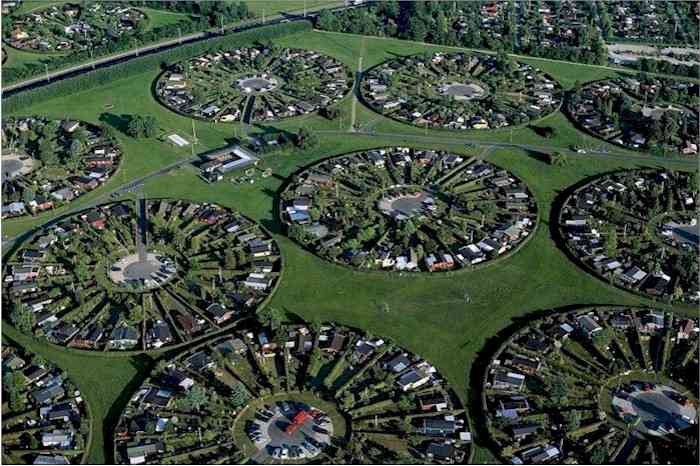
A documentary I watched a few years ago in which city planners created a suburb in Colorado based on some of the same principles as Garden City. Unfortunately, I can't remember the name of it or I would link it here. The suburb was circular in shape, with the homes of families on the perimeter and a community living space in the middle. Kind of like these housing plots in a suburb of Copenhagen, Denmark.
 |
First, the people who are able to afford a transition into places like a Garden City tend to be people from affluent, privileged communities. Rarely do those of a lower class, people who stand to gain the most from a sustainable lifestyle, have access to these kind of environmental endeavors. Underprivileged populations don't have the money to invest in cutting-edge, energy-efficient technology. They likely also don't have the resources or job security to uproot their lives and move to a utopian suburb on the outskirts of town. This brings me to my second point. Is it really environmentally responsible to create entirely new sustainable communities and leave our previous unsustainable communities in the dust to rot and decay? Or should we work on improving our already existing infrastructures? Professor Brown said in class that lots of people have tried to create the perfect utopian society, but none have succeeded. Maybe we should shift our focus from creating the best community ever to bettering what we already live in. If we work on improving our current systems, then all populations in the community are better off, not just the ones with privilege.

Laura, your last question is one that I had during class as well. Basically - "Can/should we design entirely new sustainable communities?" The normative answer seems to be clear...we should absolutely redesign existing communities if we are to succeed in reducing our land impact!
ReplyDeleteWith this in mind, I think I need to learn more about the role of urban planners in creating sustainable communities. On the one hand, these professionals must certainly think in terms of "the big picture" (city-scale), but how could such large plans possibly be flexible enough to remain relevant over the course of long-term, project-by-project redevelopment? On the other hand, isn't focusing only on isolated sustainability projects in a redeveloping community insufficient? If the whole system doesn't work well together, how can we expect any changes to stick?
I'm not sure how planners balance the plans for an ideal community with the infrastructure and resources that already exist. I suppose this is what we are in this class for, though! I hope delving deeper into the theory of "Community Capital" will be illuminating.
Great post! :)
I agree with you - I'd also like to learn more about city planning. It would be great if cities could do large-scale projects to increase sustainable lifestyles. Indy's Cultural Trail is a good example of this.
Deletehttp://indyculturaltrail.org/
Laura, you definitely made some really interesting connections here. It got me thinking all about historical development based on the Western/Christian worldview you discuss. So often we ask, why did things end up this way? There were several mentions in the Twitter conversation about Daly's steady-state economics - why didn't this catch on? These are my musings, going back to classical economics, which is a huge problem in the past, present, and future context for sustainability. Adam Smith and all his buddies were all European and Christian. They developed their theories based on this "Earth was made for us" worldview, which caught on and spread through Colonialism and the Industrial Revolution basically all over the world. Western economics, based on human-centric Christianity, is what helped to lead to "growthmania" and is why more holistic, balanced worldviews have such a problem catching on. Imagine if Adam Smith had been from India, China or Japan, if he was Hindu, Buddhist or Daoist... Obviously this ties into a lot of historical development and a whole world of what ifs, but I had never thought of the issue from a religious point of view, so (for me) it was an interesting thought experiment.
ReplyDeleteI love the thought experiment! What if Adam Smith was a practicing Hindu? Certainly with concepts like reincarnation, Hinduism lends itself to more environmentally sustainable practices! Very interesting..
DeleteYour post brings up a great point about privilege. I tend to agree that using our existing infrastructure and neighborhoods to build a more sustainable community is best. However, some might see this as gentrification. Which, might be good for improving a neighborhood (let's bring back corner stores and spruce up these apartment buildings with more efficient appliances and lighting, and let's add bike lanes and grand boulevards...etc). But it often times pushes out lower income people as the price to live in such areas increases.
ReplyDeleteSee this recent debate in the NYT: http://www.nytimes.com/roomfordebate/2014/04/13/the-pros-and-cons-of-gentrification/new-yorkers-need-to-take-back-their-city
In class, when speaking about these more sustainable communities I have heard Professor Brown mention "more diverse" neighborhoods. I think this is imperative to ensuring access to sustainable communities for all socioeconomic classes in the future. Most likely, it will need to be built in - perhaps in the way of policy or government intervention. In Indy recently, they revamped some warehouses around Mass Ave (an already trendy part of town, but nonetheless), and this housing is only for those under a certain income level.
http://www.trailsideonmass.com/
I suppose that is one way to start. Anyone else have better ideas?
Nice example of affordable housing in Indy; I know the same is happening in DC in neighborhoods with new developments. It's a good way to start building more diverse communities, but there's definitely room for more improvements.
DeleteYou are absolutely right that gentrification is a big problem for places that revamp their cities. Any improvements would likely need to be done with some level of government intervention like the one you mentioned. Thank you for bringing this up!
DeleteGreat blog Laura. Your point about privilege is extraordinarily important and something that I believe is often overlooked in sustainable development planning. This reminds me of something that I experienced this summer in Portland Oregon. As a very progressive City with a strong sustainability community, light rail and high density developments are very popular. Unfortunately, the light rail and high density developments brought young affluent folks to neighborhoods which cause rents and housing prices to skyrocket. Many people were forced to leave their neighborhoods and old cultural aspects were lost. This process of gentrification often comes along with "sustainable development" in cities, but is something that can be detrimental to communities.
ReplyDeleteYou are exactly right. I'm so glad you and kfledd brought up gentrification because it is such a serious problem and is so integral to this debate.
DeleteLaura, I think you make some insightful points about religion’s role in sustainability. You are right that religions has provided many with the impetus and justification to go against Leopold’s Land Ethic and take and destroy as they please. I have been pleased recently though to hear many of the world’s religious leaders speak out against this anti-environmentalism. Pope Francis addressed the issue in July calling environmental degradation a “sin of our time”: http://www.huffingtonpost.com/2014/07/05/pope-francis-nature-environment-sin-_n_5559631.html
ReplyDeleteA quick search also shows that the Dalai Lama also has a clear pro-environmental stance: http://www.dalailama.com/messages/environment/a-green-environment
While these two heads speak for a minority of the world’s population, this provides some hope that generally, religions are promoting respect for the environment, rather than the exploitation of the past. Additionally, this also brings up the possibility that other factors, such as political affiliation, may affect a person’s attitude as much as their religion. For instance, popular Republican politicians and pundits were extremely critical of Pope Francis when he delivered an economic critique back in January. While not exclusively on the environment, it was certainly a part of his overall message. He was blasted, called a “Marxist” by some and discredited by others (even fellow Catholic Paul Ryan):
http://takingnote.blogs.nytimes.com/2014/01/07/republicans-respond-to-the-pope/
Perhaps these people take their views from a different religion, or perhaps political beliefs are as pervasive as religious ones? I think both are important to the debate. Regardless of the source, I agree that perspectives must change to create a sustainable society.
Great point - there are dichotomies in modern Christianity. Unfortunately the Republican party seems to be on the "denier" side!
DeleteYou make a really excellent connection and point. I wonder if in other societies where Christianity is not a major religion do you see this sense of entitlement towards land and resources.
ReplyDeleteRegarding your statement that most sustainable communities are geared toward more economically privileged populations, it reminds me of what my parents have told me: that if a person does not have their basic needs met, they cannot devote time and brainspace towards things considered "intellectual". However, I think in poorer communities throughout the world, you will find that sustainability is not a choice but a necessary part of life; if you do not have ample resources, you save and reuse.
This post is Berea Antaki, by the way. Can't figure this stuff out
DeleteI think you make some great points here. One reason I love Roseland's book is that he places the same amount of importance on economic capital as cultural capital. Underprivileged communities may not have economic and human capital, but they certainly have cultural and social capital.
DeleteThat story is so interesting! Thank you for posting the links. I think we need more people like the mayor of Braddock to revive our cities! Although his methods are unconventional, he's got the passion and motivation to revamp abandoned cities.
ReplyDelete